As part of the Communication Services API category, the CAMARA WebRTC APIs aims to solve endpoint communications with all the advantages of the telecom provider’s network, but using web devices and WebRTC technology.
WebRTC technology has become a game changer for real-time communications, today we are used to video conferencing, instant streaming, web platforms for multimedia content creators and a full UC (Unified Communications) revolution. All of this is a direct result of the massive adoption of WebRTC technology.
Three APIs are presented within the WebRTC APIs:
- WebRTC Registration API: This API manages the registration and connectivity of clients to the operator’s IMS (telephony) network. It ensures that devices are properly identified and authenticated before accessing network services, which is essential for initiating or receiving audio and video sessions.
- WebRTC Call Handling API: This API enables clients to manage live audio and video sessions over the operator’s telephony network. It allows users to initiate, retrieve, update, and terminate sessions, facilitating functions such as placing calls, upgrading to video, and modifying session parameters.
- WebRTC Event Subscription API: This API enables customers to receive asynchronous cloud events related to active sessions or new session requests, such as incoming calls or negotiation invitations. It supports event subscriptions for session updates and new session invitations, enabling applications to effectively handle real-time notifications within cloud networking technologies such as orchestrated container solutions.
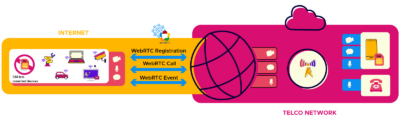 These APIs will leverage unified communications applications to deal with the public network, and they create a standardization milestone around the SDP (Session Description Protocol) exchange on WebRTC scenarios.
The main use case concept is to leverage the uniform of audio and video sessions along the telecommunications operator and reduce complexity for endpoints to reach the phone network.
Some general use cases:
- Audio video interoperability with non-SIM capable devices. Any device (drones, kiosks, IoT devices, Smart TVs and smart speakers, etc.), all of them can create calls, and reach the public phone network based on its subscriber contract.
- Connect IA generated voice and media, enabling live-transcription and live-translation, IoT commands, human-voice nature interfaces over all kind of devices, like home smart speakers, automation devices, and interoperate with modern and legacy voice endpoints.
- Bring easy and understandable tools to developers to create apps that interoperate with multiple manufacturers, cloud providers, voice, and call software providers, removing the barriers and vendor-locks for developers.
- Offer a unique language to interconnect all voice and video platforms: Private, open source, cloud, or local unified communications platform. All can be connected with the operator network and all can interact using the same language.
- Bring a modern session exchange protocol, that adapts properly to cloud infrastructures and web technologies. A real alternative to tradition SIP (Session Initiation Protocol) designed initially for UDP networks.
Let’s put a practical example:
- 👩💼 Alice is working at the office, with its company E-Kipos platform
- 🚗 Bob is traveling by car
- 👩💻 Carol is from a different company, that works with the open source Yey-tse platform
In the event that they wish to communicate with one another, each person can maintain their own experience within their own client. For example, Alice can use an enterprise solution while storing live-transcribed call subtitles, Bob can connect via phone (Bluetooth hands-free), and Carol can use its custom open-source front end.
There is no reason for vendor lock-in or platform user retention if all can share the same API to interconnect. Both developers and end-users can focus on the user experience and forget about connectivity, and interoperability of each platform or application.
Some detailed use cases for each API:
WebRTC Call Handling API:
- Initiating voice or video calls to any phone number using the operator’s network.
- Retrieving and updating ongoing sessions to manage call parameters or recover from network disruptions.
- Terminating sessions when calls are completed.
WebRTC Registration API:
- Registering devices to the network to enable audio and video communication services.
- Updating or removing device registrations as needed.
WebRTC Event Subscription API:
- Receiving notifications for incoming calls or session invitations.
- Monitoring the status of active sessions to update user interfaces or trigger specific actions.
WebRTC APIs have the following benefits:
- 🙋 Improved User Experience: By managing registrations and sessions effectively, applications can offer a more reliable and user-friendly communication experience based on modern development frameworks.
- 🚀 Network-Level Quality & Reliability – Seamless integration with the operator’s network, allowing applications to offer high-quality audio and video communication services.
- 🔄 Real-Time Interaction: With event subscriptions, applications can handle real-time notifications, adapt to network cloud architectures and ensure timely responses to incoming calls and session updates.
- 🛠️ Seamless WebRTC Integration – Simplifies development by providing standardized API endpoints for sharing connection information.
- 🔒 Secure Authentication & Registration – Ensures only authorized users and devices can access WebRTC services.
- 🔄 Operational efficiency for the API customer (cost savings).
Collectively, these APIs empower developers to build robust WebRTC applications that leverage the capabilities of the operator’s IMS network, providing users with efficient and real-time communication services.

