

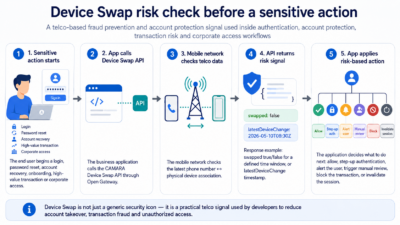
- Account Takeover Protection and risk-based Authentication: Banks, fintechs and digital services can call the Device Swap API before sensitive actions such as login, password reset, account recovery or high-value transactions. If a recent device swap is detected, the application can trigger step-up authentication, alert the user, request manual review or block the action.
- Fraud Detection in mobile Insurance Claims: Insurance providers can use Device Swap as a contextual risk signal before approving claims related to mobile devices. A recent device swap may indicate that additional verification is required before a payout is processed. See the GSMA Use Case Library: Fraud Detection in Mobile Insurance Claims.
- Secure User Access and Identity Verification: Online services can use Device Swap information to validate whether the user’s mobile line is still associated with the expected device context. If a recent change is detected, the service can require re-authentication before granting access to sensitive account functions.
- Corporate mobile Line and Policy Compliance: Enterprises managing corporate mobile plans can detect whether a company SIM is being used in a different device. This helps security and IT teams enforce device policies, reduce misuse of corporate lines and protect access to enterprise services.
- Device Transition and Customer Experience: When a device change is legitimate, service providers can use the signal to adapt security flows, refresh trusted-device status or support a smoother transition to the new device.
See also at GSMA:
- Remote Monitoring and Control: Remote Monitoring and Control
- Asset Tracking and Protection: Asset Tracking and Protektion