

THE LINUX FOUNDATION PROJECTS

Consent Management

API Description
Use Cases

The Consent Management API can be applied to various scenarios:

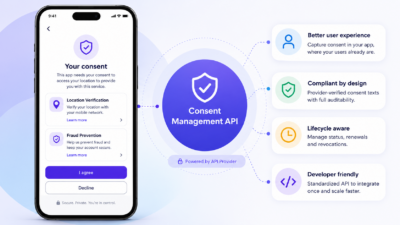
  • In-App Consent Capture for Network APIs: An application requesting access to a CAMARA network API (e.g. Number Verification, Location Verification) for fraud prevention or identity assurance can capture the user’s consent directly in its own UI, using the consent text and scope/purpose combination provided by the API provider, instead of relying on a separate provider-hosted journey.
  • Consent Status and Lifecycle Tracking: An API consumer can check whether a user has already granted, denied, or has a pending/expired consent for a given scope and purpose before invoking the underlying network API, avoiding unnecessary consent prompts and improving the user journey.
  • Consent Renewal and Revocation: When a previously granted consent expires or a user decides to revoke or re-grant access, the API consumer can update the consent record to reflect the user’s latest decision, keeping personal data processing aligned with the user’s current intent at all times.
  • Auditable Proof of Consent for Compliance: Regulated API consumers (e.g. in fraud prevention, financial services) can retrieve the exact consent text shown to the user together with the consent decision and timestamps, supporting internal compliance and audit requirements.
Benefits

Using the Consent Management API offers several advantages for developers:

  • Frictionless User Experience: Users grant or deny consent without leaving the API consumer’s application, reducing drop-off compared to redirect-based consent flows.
  • Faster Integration of Network APIs: Capturing consent directly removes the need to build and maintain a separate, provider-specific consent journey for each network API, speeding up onboarding.
  • Built-in Compliance: Consent texts are provided and verified by the API provider, and every grant, denial, revocation, and renewal is timestamped and auditable, reducing the API consumer’s regulatory burden.
  • Operational Efficiency: Standardized scope- and purpose-based queries let API consumers check consent status before triggering a network API call, avoiding unnecessary requests and improving application performance.
  • Lifecycle-aware Design: The defined consent status lifecycle (PENDING, REQUESTED, GRANTED, DENIED, EXPIRED) gives API consumers clear, predictable rules for handling renewals, revocations, and expirations programmatically.

API Portfolio: Service Management

Sub Project Wiki: N/a, Independent Sandbox, See API Wiki
(incl. how to meet the team)

API Wiki: Consent Management

API Repository: Consent Management

API Repository Status: Sandbox

API Status: Initial

API Version(s) and Release Date(s):

API availability: Information which APIs are available in which country and network, and how to get access can be found on the GSMA public launch status page.

Be part of a collaborative community driving the future of global Telco APIs.

Join Today